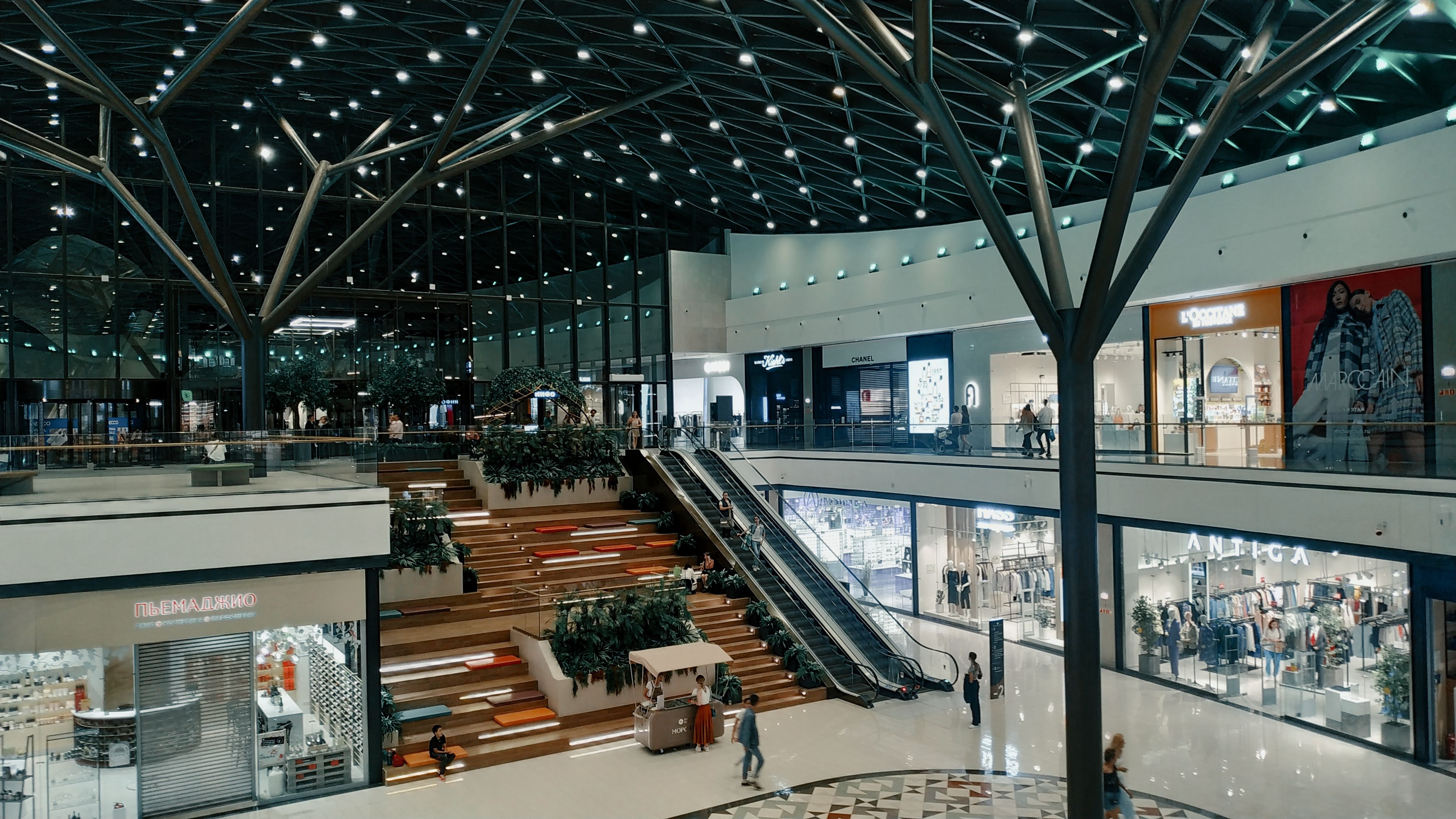
Shopping malls are places of mass gatherings with intense visitor flow. Thousands of people touch the same surfaces daily: escalators, handrails, elevator buttons, door handles. Ozonation maintains air quality, eliminates odors and provides infection prevention.
Regular ozone treatment during off-hours disinfects all surfaces, including hard-to-reach areas and technical zones. The gas penetrates all rooms, ensuring comprehensive treatment of the entire facility.
Treatment zones in shopping malls
- Shopping galleries and atriums — main visitor gathering areas
- Escalators and elevators — contact surfaces with maximum load
- Food courts — sources of odors and food contamination
- Restrooms — critical hygiene zones
- Storage and technical rooms — often ignored during cleaning
- Ventilation systems — distribute air throughout the mall
- Parking lots — accumulate exhaust fumes and odors
Odor problem in malls
Shopping malls combine many odor sources: food courts, restrooms, perfume stores, storage areas. Ozone effectively neutralizes all these odors, not masking them, but destroying the molecules of odorous substances.
| Zone | Odor source | Solution |
|---|---|---|
| Food court | Food preparation, grease, spices | Night ozonation + duct ozone generators |
| Restrooms | Organic substances | Continuous low-concentration ozonation |
| Atrium | Odor mixing, stuffiness | Ventilation integration |
| Parking | Exhaust fumes | Duct ozone generators in exhaust |
Ozonation organization options
Night treatment
Mobile ozone generators treat the mall after closing. Maximum effectiveness.
Ventilation integration
Duct ozone generators in HVAC system. Continuous air quality maintenance.
Zonal treatment
Wall-mounted ozone generators in problem zones: restrooms, food court, parking.
Combined approach
Combination of all methods for maximum effect
Treatment mode
Night disinfection
After mall closing, mobile ozone generators are started. Treatment 2-4 hours depending on area. By opening, ozone completely decomposes.
Food court
Daily treatment after cafes close. Elimination of cooking odors, disinfection of tables and chairs.
Restrooms
Low-power ozone generators work continuously at safe concentration or turn on automatically during breaks.
Ventilation
Duct ozone generators supply ozone to air ducts, ensuring supply air disinfection.
Equipment calculation
| Zone | Area | Capacity | Mode |
|---|---|---|---|
| Shopping gallery | 1000-5000 m² | 50-200 g/h | Night treatment |
| Food court | 500-1500 m² | 20-60 g/h | Daily after closing |
| Restroom | 20-50 m² | 1-2 g/h | Continuous or cycles |
| Storage | 100-300 m² | 5-15 g/h | 2-3 times per week |
| Parking | 5000-20000 m² | 100-500 g/h | Ventilation integration |
Effectiveness against pathogens
| Pathogen | Time (20 mg/m³) | Effectiveness |
|---|---|---|
| Coronaviruses | 10-15 min | 99.9% |
| Influenza viruses | 5-10 min | 99.9% |
| Norovirus | 15-20 min | 99.9% |
| Staphylococcus aureus | 10-15 min | 99.99% |
| E. coli | 5-10 min | 99.99% |
| Mold | 30-40 min | 99% |
Benefits for management companies
Visitor safety
Reduced risk of infection spread in crowded areas
Comfortable atmosphere
Clean air without odors increases visitor stay time
Regulatory compliance
Meeting sanitary requirements for public places
Chemical savings
Reduced costs for disinfectants and air fresheners
Disinfection approach comparison
Shopping mall treatment methods
| Criterion | Ozonation | Chemical treatment |
|---|---|---|
| Air treatment | Yes | No |
| Ventilation systems | Yes | No |
| Hard-to-reach areas | Yes (gas) | No |
| Odor elimination | Complete | Masking |
| Chemical residues | No | Yes |
| Automation | Full | Partial |
Safety for visitors
With proper organization, ozonation is absolutely safe for visitors and shopping mall staff.
- Main treatment — at night when the mall is closed
- Ventilation integration — at safe concentrations
- Restrooms — automatic shutdown when visitors enter
- Concentration sensors — real-time ozone level monitoring
- By opening, ozone completely decomposes into oxygen