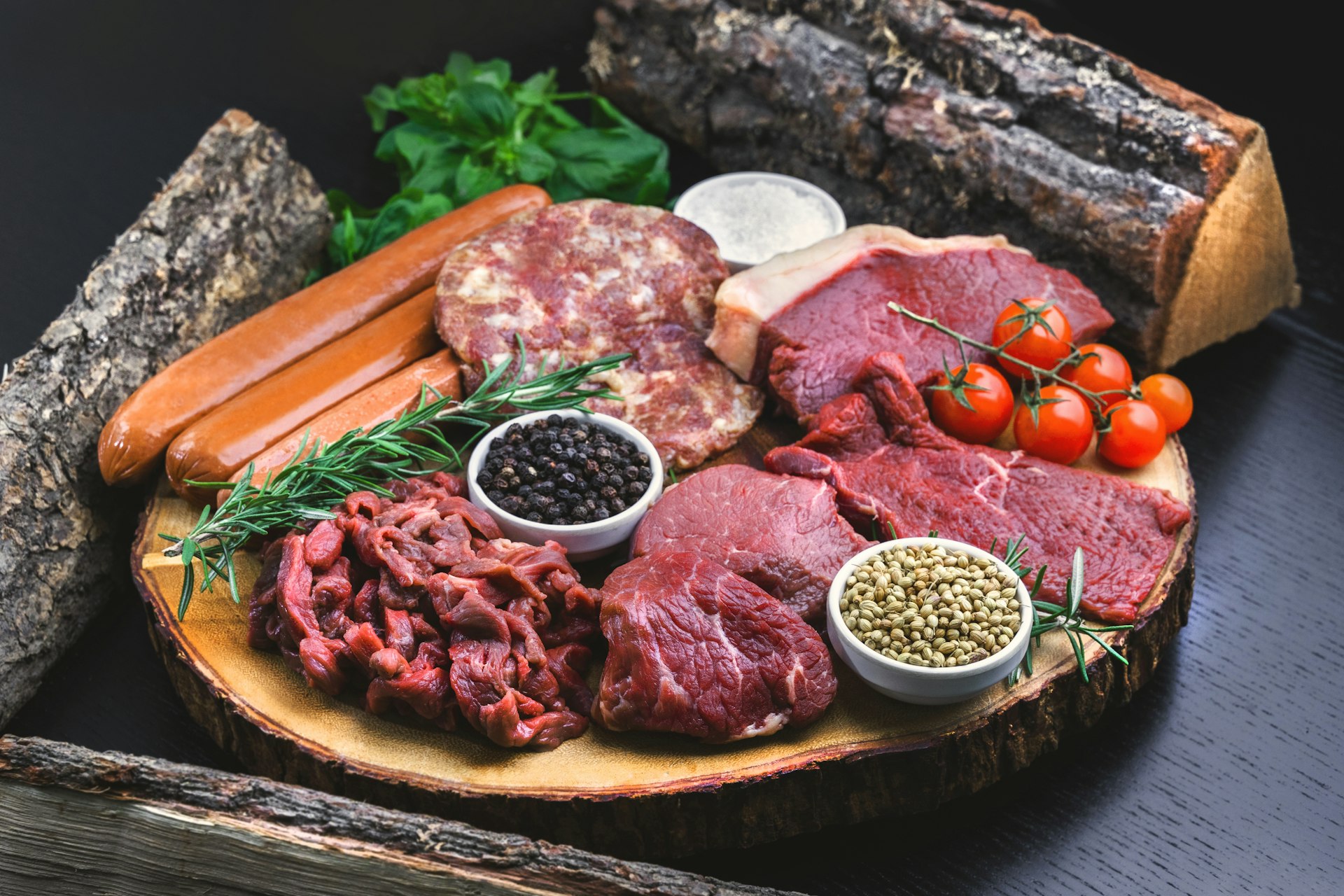
During sausage ripening and meat storage, bacteria, mold fungi and yeasts actively develop. This leads to product spoilage, taste changes, mass loss and reduced shelf life. Ozonation is an effective, eco-friendly and safe disinfection method.
Ozone's disinfecting effect is 15-20 times stronger than chlorine, and approximately 300-600 times stronger against spore-forming bacteria. At the same time, ozone completely decays to oxygen, leaving no chemical residues on the product surface.
Chilled meat storage
For chilled meat storage, ozonation at 8-10 mg/m³ ensures complete destruction of mesophilic and psychrotrophic microflora on carcass surfaces at 1-4°C. Chilled meat shelf life increases 2-5 times.
| Product | Temperature | Concentration | Treatment time | Frequency |
|---|---|---|---|---|
| Chilled meat | -1...-4°C | 8-10 mg/m³ | 4-5 hours | Every other day |
| Frozen meat | -18°C | 10 mg/m³ | 3 hours | Daily |
| Poultry (chilled) | -1...-4°C | 8-10 mg/m³ | 2-3 hours | Daily |
| Poultry (frozen) | -18°C | 8-12 mg/m³ | 3 hours | Daily |
| Offal | -1...-4°C | 8-10 mg/m³ | 3-4 hours | Daily |
Sausage ripening chambers
In ripening chambers for dry-cured and air-dried sausages, ozone suppresses development of slimy and mold deposits, preventing off-odors. At moderate concentration, ozone does not cause discoloration of casing or filling.
| Sausage type | Concentration | Treatment time | Temperature | Efficiency |
|---|---|---|---|---|
| Dry-cured | 3-8 mg/m³ | 3 hours | +12...+14°C | 96-99% |
| Cooked-smoked | 3-7 mg/m³ | 2 hours | +10...+12°C | 95-98% |
| Air-dried | 5-10 mg/m³ | 2-3 hours | +10...+15°C | 96-99% |
| Semi-smoked | 3-6 mg/m³ | 2 hours | +10...+12°C | 95-98% |
Benefits of ozonation
- Product surface disinfection — destruction of bacteria, mold spores and yeasts
- Preservation of organoleptic properties — does not change taste and aroma, prevents bitterness
- Reduced mass loss — decreases shrinkage through microflora stabilization
- Chamber disinfection together with products — treatment possible with full load
- Time and cost savings — reduced frequency of manual sanitation
- Automation — timer-based treatment without personnel involvement
Comparison of ripening chamber disinfection methods
| Parameter | Ozonation | Traditional treatment |
|---|---|---|
| Product unloading | Not required | Required |
| Chemical residues | None | Rinsing required |
| Hard-to-reach areas | Treated with gas | Inaccessible |
| Downtime | 1-3 hours/day | 24-48 hours |
| Effect on product | None | Possible |
| Automation | Full | Manual work |
Use of ozone by major global companies
Major quick-service restaurant chains (McDonald's, Burger King, Subway and similar) and leading meat processors worldwide use ozonation for meat and poultry storage, cold room and equipment disinfection. Ozone is applied in cold storage facilities, sausage ripening chambers, cutting and packaging lines, and for sanitizing surfaces and sometimes process water. These companies align with FDA, USDA and HACCP standards, where ozone is recognized as a safe and effective method.
Ozone treatment allows keeping products in chambers without unloading, reduces downtime and avoids chemical residues — which is critical for chains with strict safety and shelf-life requirements. Adopting ozone in the meat and semi-finished product supply chain is common practice among global industry players.
- Cold rooms and warehouses — extended shelf life of meat and poultry
- Sausage ripening chambers — mold suppression without unloading products
- Equipment and surface sanitation — no chemical residues
- Compliance with FDA, USDA and HACCP-style systems
Standards and regulations for ozone use in meat
Use of ozone for meat storage and processing is governed by both mandatory and voluntary norms. In the US, ozone has been approved by the FDA as GRAS (Generally Recognized as Safe) since 2001 and by the USDA for contact with meat and poultry (21 CFR § 173.368). In some countries, ozone use in cold storage and sausage production is set out in official instructions and sanitary codes; in others it is used under voluntary standards and equipment supplier guidelines. Overall, ozone is officially accepted as a safe disinfectant in the meat industry.
- FDA GRAS (USA, 2001) — ozone permitted for treatment, storage and processing of food, including meat and poultry
- USDA (USA) — allows ozone in contact with meat and poultry when GMP is followed
- 21 CFR § 173.368 — approval for ozone use in gaseous and aqueous phases per GMP standards
- Soviet/Russian instructions (1973, 1977) and SanPiN — ozonation of cold storage and sausage production
- Voluntary use under industry and corporate standards (HACCP, GMP) in many countries
Regulatory framework
Use of ozone for meat product disinfection is regulated by a number of regulatory documents from the Soviet period:
- 1973 — Instruction "Disinfection and deodorization in cold storage facilities by ozonation" (USSR Ministry of Trade)
- 1977 — Instruction on receiving, storing and releasing sausage products and smoked goods
- 1998 — Ozone added to list of disinfectants (reg. No. 0039-98/21, Russian Ministry of Health)
- SanPiN 2.3.4.545-96 — Sausage production
Benefits for meat processing plants
Extended shelf life
2-5 times longer chilled meat shelf life without freezing
Mold suppression
96-99% efficiency against mold fungi on sausages
Eco-friendliness
Complete ozone decay to oxygen without chemical residues
Production continuity
Treatment without unloading products and stopping the process