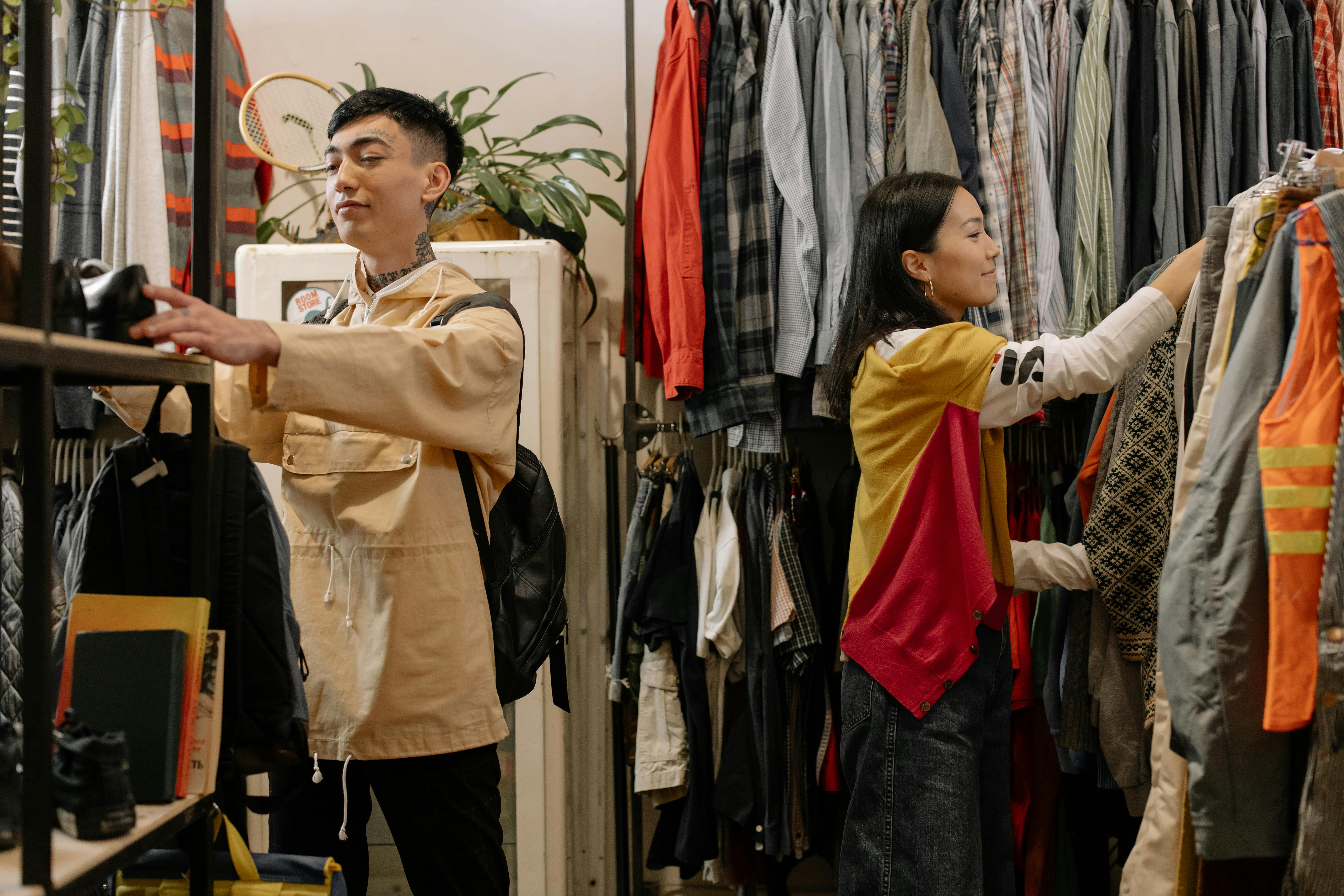
The characteristic odor of clothing in secondhand stores comes from mandatory disinfection. Before sale, items are treated with formaldehyde or methyl bromide gas to kill viruses and bacteria. The disinfectants dissipate by the time clothes reach the shelves, but the characteristic smell remains.
This odor is the main retail problem in secondhand. It fills the whole store and triggers unpleasant associations with worn clothing. Some customers spend less time in the store because of discomfort, which directly affects sales volume.
Impact of odor on sales
| Metric | With odor | After ozonation |
|---|---|---|
| Average visit time | 12 minutes | 18-20 minutes |
| Conversion to purchase | 15% | 22% |
| Average check | Baseline | +15-25% |
| Repeat visits | 25% | 40% |
| Negative reviews about odor | 35% | <5% |
Benefits of ozonation
Complete odor removal
Ozone neutralizes disinfectant molecules rather than masking them. Result — fresh air.
Treatment without unloading
All merchandise is treated simultaneously, no need to remove items from hangers.
Additional disinfection
Ozone destroys bacteria, viruses and dust mites — additional quality guarantee.
Customer comfort
Pleasant atmosphere in store = more time to choose = more purchases.
Ozonation process
Room preparation
Store closes. Windows and doors closed. Supply ventilation turned off for maximum ozone concentration.
Ozonator placement
Wall-mounted ozonator placed 40-60 cm from ceiling. Mobile — at maximum height.
Ozonation
Treatment mode activated for 1-3 hours depending on room volume.
Ventilation or waiting
For night treatment, ventilation is not needed — ozone dissipates on its own in 2-3 hours. By store opening, only a light freshness smell remains.
Equipment calculation
Ozonator capacity is selected at: 1 g/hour per 25 m³ of room volume.
| Store area | Volume | Ozonator | Treatment time |
|---|---|---|---|
| 50-100 m² | 150-300 m³ | 10 g/hour | 1-2 hours |
| 100-200 m² | 300-600 m³ | 10-20 g/hour | 2-3 hours |
| 200-400 m² | 600-1200 m³ | 20-40 g/hour | 2-3 hours |
| 400+ m² | 1200+ m³ | Multiple units | 2-3 hours |
Operating mode
- Daily night treatment — optimal mode
- Automatic start on timer after store closing
- By morning ozone completely dissipates, freshness remains
- No staff involvement required — full automation
- For strong odor — first 3-5 days treatment for 2-3 hours
Solution economics
| Expense item | Without ozonation | With ozonation |
|---|---|---|
| Air fresheners | 5-15 thousand ₽/month | 0 ₽ |
| Electricity | — | 500-1000 ₽/month |
| Losses from dissatisfied customers | Significant | Minimal |
| Equipment cost | — | 22-35 thousand ₽ (one-time) |
Additional advantages
- Higher product appeal — items perceived as better quality
- Destruction of dust mites — important for allergy sufferers
- Room disinfection — infection spread prevention
- Mold removal — relevant for basement premises
- Marketing advantage — odor-free secondhand store
Recommended equipment
| Model | Capacity | Application | Cost |
|---|---|---|---|
| OZ-A10 | 10 g/hour | Stores up to 250 m³ | from 22,000 ₽ |
| OZ-A10(N) | 10 g/hour | Wall-mounted installation | from 32,000 ₽ |
| OZ-A20 | 20 g/hour | Stores up to 500 m³ | from 34,000 ₽ |