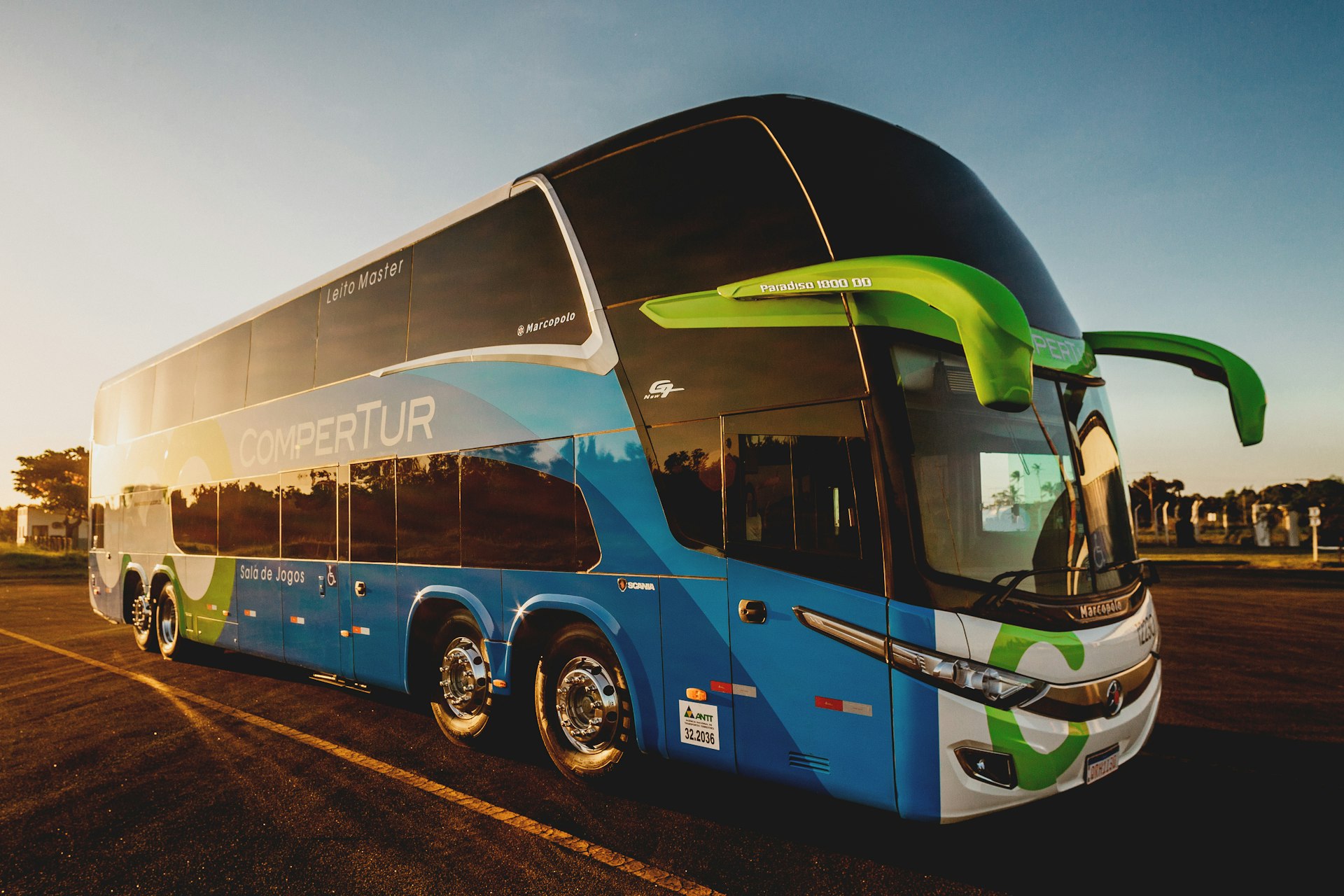
Urban public transport is an environment with high contact intensity between people. Hundreds of passengers pass through the bus interior daily, touching handrails, seats, stop buttons. During epidemics, the risk of infection transmission increases manyfold.
Ozonation provides deep disinfection of all interior surfaces, including hard-to-reach areas: upholstery gaps, ventilation system, space under seats. Unlike wiping with disinfectants, ozone gas penetrates everywhere and leaves no chemical residues.
Sanitation issues in public transport
The passenger bus interior is a favorable environment for microorganism growth. Engine heat, humidity from passenger breathing, and organic contamination create ideal conditions for bacteria, viruses, and fungi.
- Handrails and handles — main source of contact infection transmission
- Fabric seat upholstery absorbs moisture, odors, and microorganisms
- Ventilation system spreads aerosol particles throughout the interior
- Floor coverings accumulate dirt and pathogens from shoes
- Hard-to-reach areas are not treated during regular cleaning
Bus ozonation technology
Bus interior ozonation is a simple procedure that does not require special staff qualifications. The main thing is to follow the treatment regime and safety rules.
Interior preparation
Close all windows and doors. If necessary, perform preliminary wet cleaning to remove large contaminants.
Ozonator placement
Install the ozonator in the center of the interior or in the aisle at maximum height. Connect to electrical network (220V/230V) or external power source.
Ozonation
Turn on the ozonator, leave the interior and close the door. Treatment time 20-40 minutes depending on volume and contamination level.
Ventilation
Open all doors and windows, turn on standard ventilation. Ventilate for 15-20 minutes until ozone is completely removed.
Treatment modes for fleets
| Treatment mode | Concentration | Time | When to apply |
|---|---|---|---|
| Express between runs | 10-15 mg/m³ | 15-20 min | At terminal stops, breaks |
| Standard nightly | 15-20 mg/m³ | 30-40 min | Daily at depot |
| Deep disinfection | 25-30 mg/m³ | 60 min | Weekly or after incidents |
| Seasonal treatment | 20-25 mg/m³ | 90 min | Before epidemic season |
When choosing a mode, consider route load, season (more intensive treatment during epidemics), interior condition. Regular ozonation reduces the need for deep treatment.
Efficiency against pathogens
Ozone destroys a wide range of microorganisms relevant to public transport:
| Pathogen | Inactivation time | Efficiency |
|---|---|---|
| Influenza A/B viruses | 5-10 min | 99.99% |
| Coronaviruses (SARS-CoV-2) | 10-15 min | 99.99% |
| Norovirus | 15-20 min | 99.9% |
| Staphylococcus aureus | 10-15 min | 99.99% |
| E. coli | 5-10 min | 99.99% |
| Candida fungi | 15-20 min | 99.9% |
| Mold spores | 30-40 min | 99.9% |
Interior odor removal
In addition to disinfection, ozonation effectively removes unpleasant odors that accumulate in the bus interior:
- Sweat and human body odor from high passenger flow
- Food odors from items passengers carry
- Tobacco smoke from clothing of smoking passengers
- Musty odor from damp upholstery and floor coverings
- Odors from air conditioning system with accumulated mold
- Specific odors after transporting certain passenger categories
Ozone oxidizes odor molecules rather than masking them. The result is truly clean air, not a mixture of odors with fragrance. This is especially appreciated by morning route passengers.
Integration into fleet schedule
Night treatment
Buses are ozonated at the depot from 23:00 to 05:00. One operator treats the entire fleet
Between shifts
Express treatment during driver shift changes. 15-20 minutes — and the bus is ready for the next run
At terminal stops
Compact ozonator runs from bus power during terminal stop
No bus downtime
Ozonation does not require taking vehicles out of service — treatment during standard breaks
Fleet ozonation economics
Comparison of bus sanitation methods
| Parameter | Ozonation | Manual disinfection |
|---|---|---|
| Time per bus | 20-40 minutes | 60-90 minutes |
| Staff | 1 person per fleet | 1 person per 3-5 buses |
| Consumables | Electricity only | Disinfectants, rags, gloves |
| Surface coverage | 100% | 60-70% |
| Ventilation treatment | Yes | No |
| Odor removal | Complete | Partial (masking) |
Equipment for fleets
Mobile and wall-mounted ozonators are used for urban bus ozonation:
- Mobile ozonators (5-30 g/h) — carried between buses, universal
- Wall-mounted ozonators (10-20 g/h) — installed permanently in interior
- 220V/230V power — from electrical network, no external connection needed
- 220V power — for treatment at depot from fixed network
- Timers and remote control — process automation
| Bus type | Interior volume | Capacity | Treatment time |
|---|---|---|---|
| Small class (PAZ) | 15-20 m³ | 5-10 g/h | 15-20 min |
| Medium class (LiAZ) | 40-50 m³ | 10-20 g/h | 20-30 min |
| Large class (articulated) | 80-100 m³ | 20-30 g/h | 30-40 min |
| Electric buses | 50-60 m³ | 10-20 g/h | 25-35 min |
Regulatory compliance
Passenger transport ozonation complies with requirements:
- SanPiN 2.1.2.2645-10 — requirements for transport sanitary condition
- GOST R 51617-2014 — passenger transport services
- Rospotrebnadzor methodological recommendations for transport disinfection
- Regional requirements for public transport sanitation
Safety rules
Ozone in high concentrations is harmful to breathe. Follow safety rules:
- Treatment only when no people are in the interior
- Leave the bus immediately after turning on the ozonator
- Do not open doors until treatment cycle is complete
- After treatment — mandatory ventilation for 15-20 minutes
- If early entry is necessary — use respirator with carbon filter
- Store ozonator in a ventilated room